
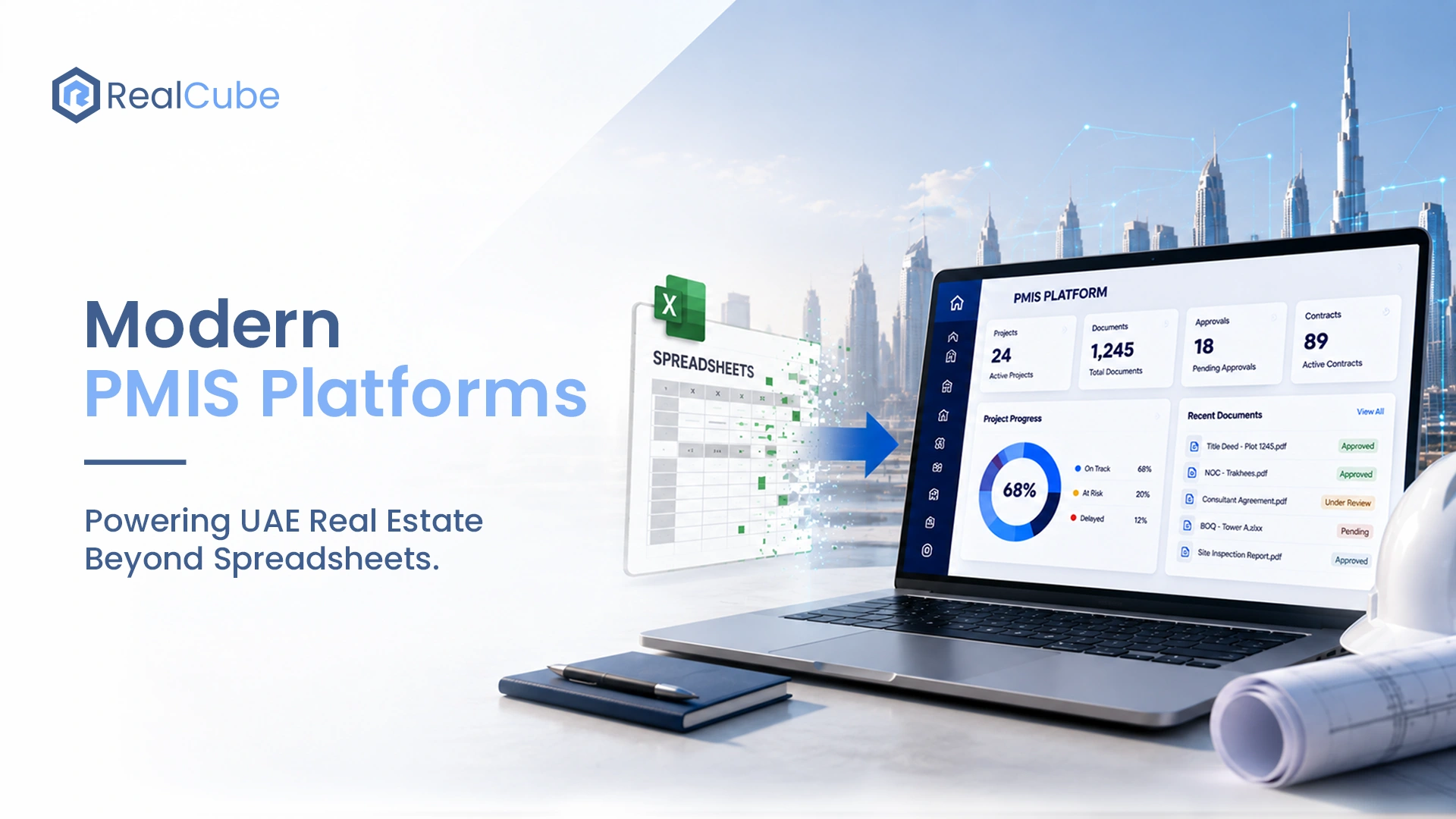
The Spreadsheet Era Is Over for UAE Real Estate
Real estate development in the UAE has never been more ambitious. With Dubai recording over AED 917 billion in property transactions in 2025 and Abu Dhabi Vision 2030 driving a wave of mixed-use megaprojects, the scale and complexity of what developers must manage has grown exponentially. Yet, in the back offices of many project teams, the workhorse remains unchanged: a spreadsheet.
This is not an indictment of developers or their teams. Spreadsheets have earned their place - they are fast, familiar, and flexible in the early stages of any project. The problem is one of scale. When your portfolio spans five active construction sites, thirty consultants, a hundred contractors, and a RERA-mandated escrow trail, a spreadsheet does not just become inconvenient. It becomes a genuine business risk.
A growing number of UAE’s leading real estate developers are recognising this and making the move to a dedicated Project Management Information System (PMIS). Not because it is a trend, but because the market and the regulators demand it. Here’s why that shift is happening - and what a modern, purpose-built real estate PMIS like RealCube actually changes on the ground.
| AED 917B+ UAE transactions in 2025 (Dubai DLD) | 40% of E&C firms faced >20% cost overruns (KPMG) | 35% Rise in RERA construction monitoring |
A Market That Has Outgrown Manual Management
The UAE property development landscape in 2025 and 2026 is operating under conditions that reward precision and penalise guesswork. Regulatory frameworks have matured considerably. RERA now links escrow fund releases to independently verified construction milestones. DLD’s digital infrastructure mandates structured, auditable documentation for every off-plan transaction. Penalties for non-compliance range from AED 50,000 to AED 500,000, with repeat offenders facing project registration suspension.
At the same time, investor expectations have risen. International buyers, institutional funds, and sovereign wealth partners expect transparent, real-time reporting on project progress. A PDF status report compiled three weeks ago does not meet that bar.
“RERA increased its monitoring of construction timelines and escrow account usage by an estimated 35% in recent oversight updates. Developers who manage milestones manually are running an audit risk they may not fully appreciate.”
The global picture reinforces the urgency. KPMG’s 2023 Global Construction Survey found that 40% of engineering and construction firms experienced schedule delays or cost impacts of more than 20% in a single reporting period. The primary driver cited was poor risk visibility - which is, at its core, a data problem. And data problems originate from fragmented, unconnected tools.
Five Ways Spreadsheets Are Costing You More Than You Realise
Let’s be specific about the failure modes that make spreadsheet-dependent development management genuinely dangerous at enterprise scale.
▶ Data Silos That Fragment Your Organisation
Your land team models feasibility in one workbook. Your design team tracks transmittals in another. Your contractor manages RFIs in a shared drive that half the team cannot access. Your finance team reconciles invoices against a separate cost tracker. These systems do not talk to each other, and the gaps between them are where budget overruns are born, and schedule risks go undetected.
▶ Version Control Nightmares
Who has the latest version of the cost plan? Is it the one emailed last Tuesday, or the one someone edited offline on Wednesday? In active construction environments, version conflicts lead to decisions being made on outdated data. At scale, this is not a minor inconvenience - it is a governance failure.
▶ Delayed Reporting That Blindsides Leadership
When project managers spend more than a day per week manually compiling status reports - a reality for 45% of project managers globally according to PMI research - leadership is always looking at the rear-view mirror. By the time a budget variance reaches the executive's dashboard, the opportunity to respond has often already passed.
▶ Budget and Schedule Risks That Accumulate Silently
Spreadsheet formula errors are not theoretical. Research estimates that the construction industry loses vast sums annually due to miscalculations in cost models, transposed figures in subcontractor applications, and labour rates omitted from master trackers. Each error is individually small. Cumulatively, they erode project margins in ways that only become visible after the damage is done.
▶ Compliance Exposure Under RERA and DLD
RERA’s 2025 requirements mandate milestone-linked escrow releases, verified by DLD-backed inspectors. Developers who maintain milestone records in spreadsheets face a structural audit risk. A single missing or mislabelled document in an escrow of reconciliation can trigger regulatory scrutiny. The cost of that - financially and reputationally - far exceeds any savings from avoiding a digital platform.
What a Modern Real Estate PMIS Platform Actually Does
A Project Management Information System is not simply ‘better spreadsheets’. It is a fundamentally different model for how development information flows, how decisions get made, and how governance is enforced. RealCube PMIS is built specifically for real estate developers in the UAE and GCC, meaning it handles the full development lifecycle from land identification to title deed issuance within a single, governed platform.
| Land Banking & Feasibility GIS-enabled plot visualisation and ROI modelling replace static spreadsheet assumptions. | Common Data Environment Every BIM/CAD drawing, transmittal and RFI lives in one versioned repository. |
| Automated Workflow Engine Stage-gate approvals enforce governance from Design through Tender to Handover. | Construction & EVM Controls 15 pre-built construction forms, H&S logs, and Earned Value Management in real time. |
| NOVA AI Intelligence Predictive analytics and anomaly detection act as your 24/7 internal auditor. | ERP & Gov API Integration Connects with Primavera P6, SAP, DLD APIs and escrow systems seamlessly. |
Spreadsheets vs. RealCube PMIS: A Direct Comparison
The table below outlines the core differences across the dimensions that matter most to UAE real estate developers.
| Criterion | Traditional Spreadsheets | RealCube PMIS Platform |
| Data Centralisation | Siloed across teams & emails | Single source of truth - CDE |
| Version Control | Multiple conflicting file versions | Strict document versioning & audit trail |
| Real-Time Visibility | Delayed, manually compiled reports | Live dashboards & EVM tracking |
| Budget Governance | Formula errors cause silent overruns | Stage-gate approvals lock budget changes |
| RERA / DLD Compliance | Manual milestone records, audit risk | Automated milestone & escrow documentation |
| Schedule Management | Static Gantt - no cascade updates | Native P6 / MSP integration, live Gantt |
| Risk Detection | Reactive - post-event discovery | NOVA AI anomaly detection (proactive) |
| Scalability | Breaks at multi-project scale | Enterprise portfolio-level management |
| Collaboration | Email chains, shared drives | Role-based workflows & contractor portal |
| Audit Trail | Partial / easy to tamper | Immutable, timestamped activity log |
What Changes When You Make the Move
The tangible impact of transitioning from spreadsheet-based management to a unified real estate PMIS platform shows up across four dimensions that matter directly to project outcomes and investor confidence.
▪ Visibility becomes real-time, not retrospective. Project directors can see live cost-to-complete, earned value metrics, and contractor performance across every active project simultaneously - from any device, anywhere.
▪ Governance becomes structural, not personal. Stage-gate approvals enforce the rule that no project proceeds from Design to Tender to Construction without meeting defined financial and compliance criteria - regardless of who is in the room.
▪ Compliance becomes demonstrable, not assumed. Every RERA milestone, escrow release, and DLD document submission is timestamped, versioned, and audit-ready by default. There is no scramble before an inspection.
▪ Risk detection becomes proactive, not reactive. NOVA AI continuously monitors anomalies - duplicate contracts, unapproved budget variations, mismatched payment records - and flags them before they escalate.
| Real-Time Portfolio visibility across all projects | Zero Manual report compilation needed | 100% Milestone-linked escrow documentation | NOVA AI Proactive anomaly detection 24/7 |
How to Lead a Successful PMIS Transition in Your Organisation
Moving from spreadsheets to a PMIS is as much a change of management exercise as a technology decision. Here are the principles that successful UAE developers follow when making this transition.
▪ Start with governance design, not software configuration. Define your stage-gate criteria, approval hierarchies, and compliance checkpoints first. A PMIS should encode your process, not impose a foreign one.
▪ Engage contractors and consultants early. The value of a Common Data Environment is only realised when every stakeholder is working from the same system. Early onboarding reduces resistance and builds the data quality the platform depends on.
▪ Align your PMIS implementation with RERA compliance milestones. Use the regulatory calendar as your go-live anchor. Teams that connect their PMIS adoption to a live compliance requirement embed the tool in real workflows faster.
▪ Integrate with your scheduling tools from day one. RealCube’s native integration with Primavera P6 and Microsoft Project means to schedule data flows into the platform automatically - eliminating the double-entry problem that undermines adoption in early implementations.
▪ Let NOVA AI surface your first insights before the first project review. The anomaly detection layer works immediately on existing data. Schedule an executive briefing around its initial findings to build internal credibility for the platform.
Frequently Asked Questions
Q1: What is a PMIS and why do UAE real estate developers need it?
A Project Management Information System (PMIS) is a unified digital platform that centralises all data, workflows, documents, and financials across the development lifecycle - from land acquisition to handover. UAE developers need it because the regulatory environment (RERA, DLD, escrow milestone laws) demands structured, auditable records that spreadsheets simply cannot reliably provide at scale.
Q2: How does RealCube PMIS differ from generic project management software?
RealCube PMIS is purpose-built for UAE and GCC real estate, meaning it handles region-specific requirements such as DLD title deed tracking, RERA-compliant escrow milestone documentation, and government API integrations that generic Western PMIS tools overlook. It also integrates natively with Primavera P6, SAP, and estimation tools like Candy RIBs.
Q3: Can RealCube PMIS replace spreadsheets completely?
Yes, for all project management and governance functions. RealCube replaces spreadsheets for feasibility modelling, design coordination, contractor management, budget tracking, and reporting - replacing static, error-prone files with a dynamic, real-time workspace accessible from any device.
Q4: How does NOVA AI improve project outcomes for developers?
NOVA AI is RealCube’s proprietary intelligence engine. It detects anomalies like duplicate contracts or unapproved budget variations in real time, forecasts schedule risks before they materialise, and provides a conversational interface so project directors can query live data instantly - turning reactive management into a proactive discipline.
Q5: Is RealCube PMIS suitable for large multi-project portfolios?
Absolutely. RealCube is built for enterprise-scale real estate developers managing multiple concurrent projects across Dubai, Abu Dhabi, and the wider GCC. Its portfolio-level dashboards, role-based access control, and centralised master data management make it the right choice for developers who have outgrown siloed spreadsheet environments.
The Right Platform for the UAE’s Development Ambitions
The UAE’s real estate sector is one of the most dynamic and well-regulated development markets in the world. The projects being delivered here - in scale, speed, and complexity - are world-class. The management infrastructure behind those projects should be too.
Spreadsheets served a purpose. That purpose has been outgrown. The combination of a maturing regulatory framework, growing portfolio complexity, and rising investor expectations has created a clear case for digital project management for real estate developers - not as a future investment, but as an operational necessity right now.
RealCube PMIS is purpose-built for this market. It is not a generic tool repurposed for UAE real estate - it is designed from the ground up to handle the specific compliance, governance, and lifecycle requirements that make development management in the UAE unique. From land banking and feasibility to construction controls and title deed issuance, every module exists to replace fragmented processes with a single, governed, intelligent workflow.
If your team is still managing RERA milestones, contractor performance, and budget forecasts across separate spreadsheets and email chains, the question is not whether you should make the move. The question is how long you can afford to wait.
CTA-
Take Control of Your Development Portfolio ,
Stop managing billion-dirham projects with spreadsheets. Switch to the PMIS that governs your costs, schedule, and RERA compliance in one unified platform.
Talk to Our Experts at realcube.estate
*Note (approx.):- Third-party statistics and market figures cited in this article are drawn from publicly available sources and industry reports (KPMG, DLD, RERA, PMI) for illustrative purposes. Readers are advised to independently verify all data before external publication or regulatory submission.