
Every development starts with land - and plenty of developments are quietly put at risk in this very first step. A site that looked promising on a broker's PDF turns out to carry zoning restrictions nobody checked. A financial model built under deadline pressure overstates the buildable GFA. A “great deal” gets fast-tracked past the people who should have reviewed it. In fast-moving markets like the UAE, where land deals and off-plan launches are being announced almost weekly, the pressure to move quickly on acquisitions has never been higher - and neither has the cost of getting it wrong.
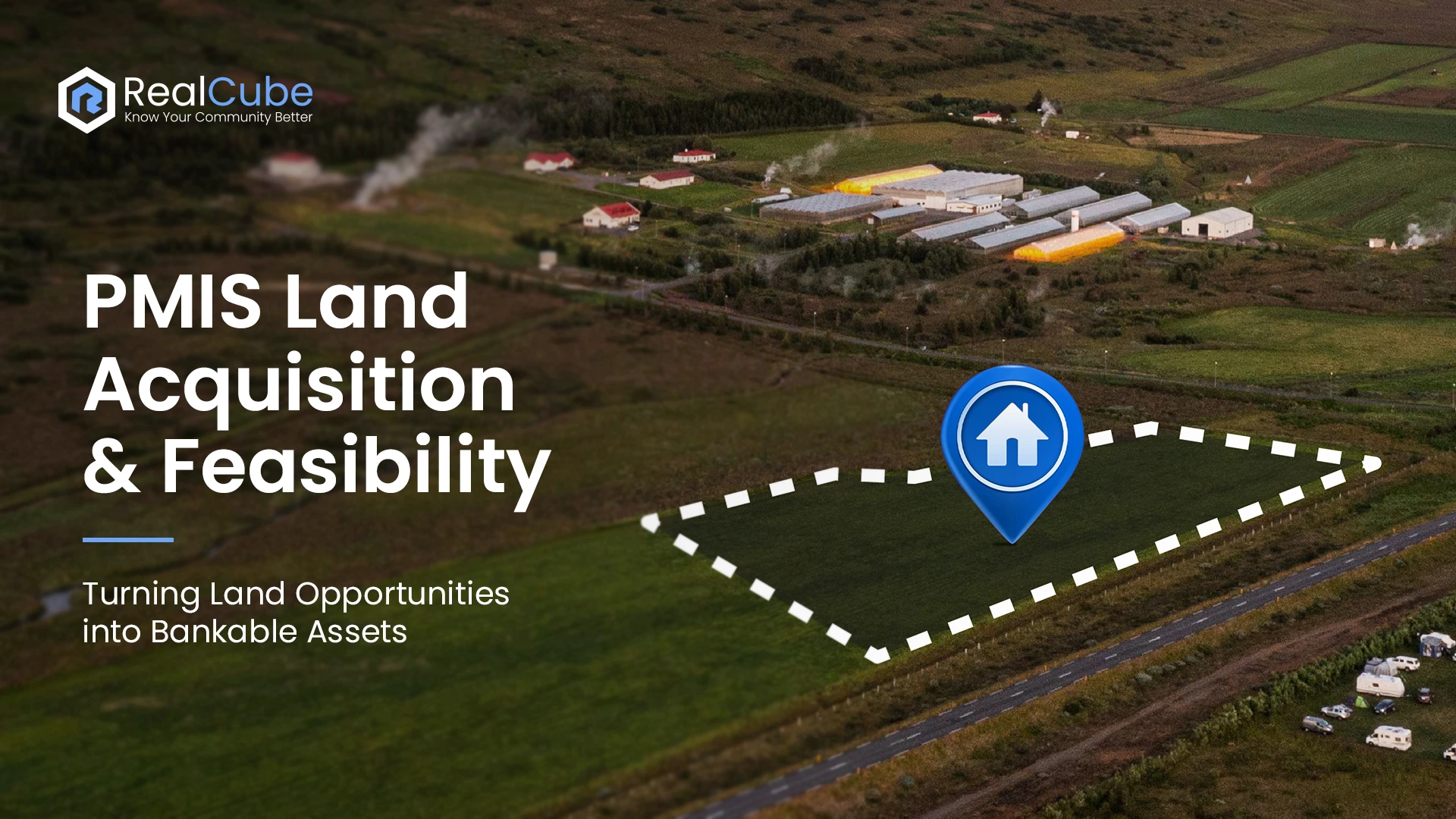
That is precisely the gap RealCube's PMIS Land Acquisition & Feasibility module is designed to close. As part of RealCube's broader Project Management Information System, it gives developers, investment teams, and leadership a single, governed home for every land opportunity - from the first site visit to the final approval that turns a parcel into a project.
The Hidden Cost of “Gut Feel” Land Decisions
Ask most development teams how they evaluate land, and the honest answer is usually some combination of email threads, shared drives, and a spreadsheet that someone updates “when they get a chance.” On paper, this looks manageable. In practice, it creates three very real problems.
- Opportunities get lost in the noise. When land leads sit in personal inboxes and folders, leadership has no single view of total exposure, total potential GFA, or how one opportunity compares to another across the portfolio.
- Approvals happen without a paper trail. Without a structured review step, a parcel can move from “interesting” to “under contract” with no record of who checked the zoning, who validated the numbers, or whether the deal actually met the company's return thresholds.
- Research goes stale the moment it's saved. A market comparison done in January is often still the basis for a decision made in June - even though prices, supply, and competing launches have moved on.
Individually, each of these feels minor. Together, they describe a development pipeline being run on hope rather than on a structured, auditable real estate feasibility analysis - and that's an expensive way to build a land bank.
From Opportunity to Asset: How RealCube's Land Acquisition Management System Works
RealCube's land acquisition management system is built around a simple idea: every parcel should move through the same structured journey, with the same data quality, regardless of who sourced it or how the conversation started. That journey runs across four connected stages.
Stage 1: A Living Pipeline, Not a Pile of PDFs
Every land opportunity enters the system as a structured record - ownership details, exact coordinates, total area, intended use (residential, mixed-use, commercial, and so on), and the source of the lead. Instead of a folder full of disconnected documents, leadership gets a live pipeline view of every parcel under consideration, where it stands, and how it compares to everything else in the portfolio.
Stage 2: Site Selection and Feasibility Screening, Side by Side
Once a parcel is in the pipeline, the team moves into a shared market assessment workspace. Research notes, comparable transactions, and supporting documents are stored alongside the parcel itself - not in a separate drive that someone forgets to update. Teams can search and filter opportunities by location, intended use, and availability, and apply simple colour-coded feasibility ratings (from high-potential “green” sites through to “rejected”) so that priorities are visible at a glance. This turns site selection and feasibility analysis from a one-off report into an ongoing, shared view that the whole investment team can work from.
Stage 3: Turning a Site Into a Business Case
This is where the module connects directly into RealCube's pre-estimation engine - the heart of its project feasibility software. Land parcel and GFA calculators, combined with building-mix planning tools, translate a raw plot into a realistic development scenario: how much can actually be built, in what configuration, and at what density. From there, the system supports inventory valuation and sales projection forecasting, so the team isn't just asking “what could we build here,” but “what would it be worth if we did.” The result is a real, numbers-backed business case rather than a back-of-envelope estimate.
Stage 4: Governance That Travels With the Deal
Once the model is ready, it doesn't just sit in someone's inbox waiting for a verbal “yes.” A formal stage-gate review and approval workflow routes the opportunity to finance and senior leadership, who assess the ROI, market assumptions, and risk factors as a structured step - not an afterthought. Every comment, revision, and sign-off is captured, so that by the time a parcel is handed to the purchase team, there is a complete, fully auditable record of how and why the decision was made.
WHY IT MATTERS
A structured, four-stage workflow means no parcel skips a step - and no capital gets committed without a documented answer to “why this site, and why now.”
One Connected System: From Feasibility to Master Plan
The real value of RealCube's PMIS for real estate development isn't any single screen - it's what happens to the data afterwards. Because Land Acquisition & Feasibility sits inside the same platform as the rest of the PMIS suite, the information captured during feasibility doesn't disappear once a decision is made.
- Pre-Estimation: The area, GFA assumptions, and building-mix scenarios used during feasibility flow directly into cost estimation, so the numbers used to justify the purchase are the same numbers the design and budgeting teams start with.
- Title Deed Management: Once a parcel is acquired, it moves into the Title Deed Master, where GIS plot rendering and integration with government records support the legal and ownership lifecycle of the asset going forward.
- Master Plan and Project Setup: The same area, GFA, and intended-use data that justified the acquisition becomes the foundation for the project's master plan - so nothing has to be re-keyed, re-explained, or reconstructed from memory weeks later.
For developers comparing land acquisition software options, this end-to-end continuity is the real differentiator. A feasibility study that lives in isolation is just a document. A feasibility study that becomes the project's master plan is a genuine real estate development software advantage.
NOVA AI: Your Feasibility Co-Pilot
Sitting across the entire Land Acquisition & Feasibility workflow is NOVA AI, RealCube's built-in intelligence layer. During the acquisition stage - arguably the moment when good information matters most - NOVA AI adds a layer of analysis that a static spreadsheet simply can't offer.
- Predictive analytics for investment: NOVA AI reviews the data already sitting in your pipeline to help forecast revenue potential and surface financial risks before capital is committed - a core part of any serious investment feasibility management process.
- Data-driven CapEx planning: Rather than relying on last year's assumptions, NOVA AI helps guide pricing and CapEx decisions using current data from across your portfolio.
- Faster reviews, fewer bottlenecks: By analysing how feasibility approvals typically move through your organisation, NOVA AI can highlight recurring delays and suggest workflow shortcuts - helping good deals move at the speed the market demands.
- Conversational access for leadership: Investment directors and C-suite stakeholders can simply ask NOVA AI about pipeline status or a specific site's feasibility numbers in plain language, instead of waiting for someone to pull a report together.
Why This Matters Right Now for GCC Developers
This isn't a theoretical problem. The UAE real estate market has been on a remarkable run - Dubai alone closed 2025 with more than 270,000 transactions worth roughly AED 917 billion, up around 20% year-on-year, and Q1 2026 carried that momentum forward with AED 252 billion in transactions, a 31% jump in value. Off-plan activity continues to dominate, accounting for roughly 70 to 72% of residential transactions in early 2026, and with well over 100,000 new units scheduled for handover across 2026, competition for well-located land is intense.
In a market moving at this pace, the developers who win the best sites are the ones who can move from “interesting opportunity” to “governed decision” the fastest - without skipping the checks that protect their capital. That's exactly the balance RealCube's land acquisition management system is built to strike: speed where it counts, and governance where it matters.
| UAE Real Estate Snapshot (2025-Q1 2026) | What It Means for Land Acquisition |
| Dubai: 270,000+ transactions, ~AED 917bn value in 2025 (+20% YoY) | A high-volume market rewards teams that can screen and act on opportunities quickly |
| Q1 2026: AED 252bn in transactions, +31% YoY value | Momentum is continuing - land pipelines need to keep pace with demand |
| Off-plan share: ~70-72% of residential transactions, Q1 2026 | Feasibility and pre-sales modelling matter earlier in the project lifecycle |
| 120,000+ new units scheduled for handover across 2026 | A crowded supply pipeline raises the bar for site selection and differentiation |
Figures are based on Dubai Land Department data as reported via Savills and industry market trackers through Q1 2026, and should be reviewed for the latest published updates before further usage than here.
Built for Governance, Not Just Speed
Plenty of tools can help a team list land opportunities. Far fewer treat land as the first stage-gate in a governed project lifecycle. RealCube's PMIS Land Acquisition & Feasibility module is built on the principle that a land decision is also a portfolio decision - and should be reviewed with the same rigour as any other major capital commitment.
As part of a broader real estate project management software ecosystem that also covers pre-construction, procurement, project controls, and title deed management, this module gives developers a property development planning software foundation that doesn't need to be rebuilt at every stage. The feasibility study isn't a one-time exercise that gets filed away - it's the starting data set for everything that follows.
STOP GUESSING. START GOVERNING.
Don't let your next land acquisition be a gamble. With RealCube's PMIS Land Acquisition & Feasibility module, every opportunity is screened, modelled, and approved on a single governed platform - ready to flow straight into your project's master plan. Talk to our team to see it in action. https://www.realcube.estate/