
Ask any facility manager in Dubai, Abu Dhabi, or Sharjah what keeps them up at night, and the answer is rarely one big crisis. It's the accumulation of small ones: a chiller that fails in July because a filter change was missed, a vendor invoice that doesn't match the SLA, a fire-safety checklist buried in someone's inbox. In a market managing a growing share of the region's built environment, that kind of firefighting isn't just inefficient - it's expensive and, increasingly, a compliance risk.
This is exactly the gap facility management software in the UAE is built to close. But not every platform on the market is built for how UAE buildings, teams and regulators actually operate. This piece walks through what a genuinely useful CAFM software UAE deployment looks like - the features that move the needle, not just the ones that look good on a brochure.
Why UAE Facility Managers Need More Than a Generic CMMS
The UAE's facility management sector has scaled fast, and its needs are now distinct from generic, one-size-fits-all software built for other markets. Three regional realities shape what a facility management system here really needs to do:
- Extreme climate load. HVAC and cooling assets run under sustained heat stress for most of the year. A missed preventive maintenance cycle doesn't just shorten equipment life - it can take a building offline within hours during peak summer months.
- Layered compliance requirements. Dubai Municipality, Civil Defence, ADDC, DEWA and emerging federal sustainability mandates all expect audit-ready documentation. Manual logs make inspections stressful; digital, timestamped records make them routine.
- Multi-vendor, multi-site operations. Whether it's a single tower or a portfolio spanning several emirates, most UAE facilities rely on outsourced contractors for hard and soft services alike, which means SLA enforcement and vendor accountability have to be built into the system, not bolted on.
A facility management platform that ignores these realities ends up being just a digital filing cabinet. The ones that matter are the ones built around how facilities in this region actually run.
Facility Management Software UAE: Key Features That Actually Matter
1. Preventive Maintenance Software, Not Just Reactive Ticketing
The single biggest shift a computer-aided facility management platform enables is moving from reactive repairs to preventive maintenance software that schedules servicing based on manufacturer guidance, asset age, and real usage patterns. Instead of technicians responding to breakdowns, PPM (Planned Preventive Maintenance) schedules trigger work automatically - extending asset life and protecting the budget from expensive emergency call-outs.
2. Complete Asset Management Software UAE Teams Can Actually Trust
A facility is only as manageable as its data. Strong asset management software UAE operators rely on maps every asset to a functional location - building, floor, unit, and equipment - and keeps a full lifecycle history: installation date, warranty status, past repairs, and spare-parts consumption. This single detail eliminates two of the most common losses in FM: redundant repairs on equipment nobody knew already had a fix logged, and missed warranty claims because no one could produce the paperwork.
3. Work Order Management Software That Works in the Field, Not Just the Office
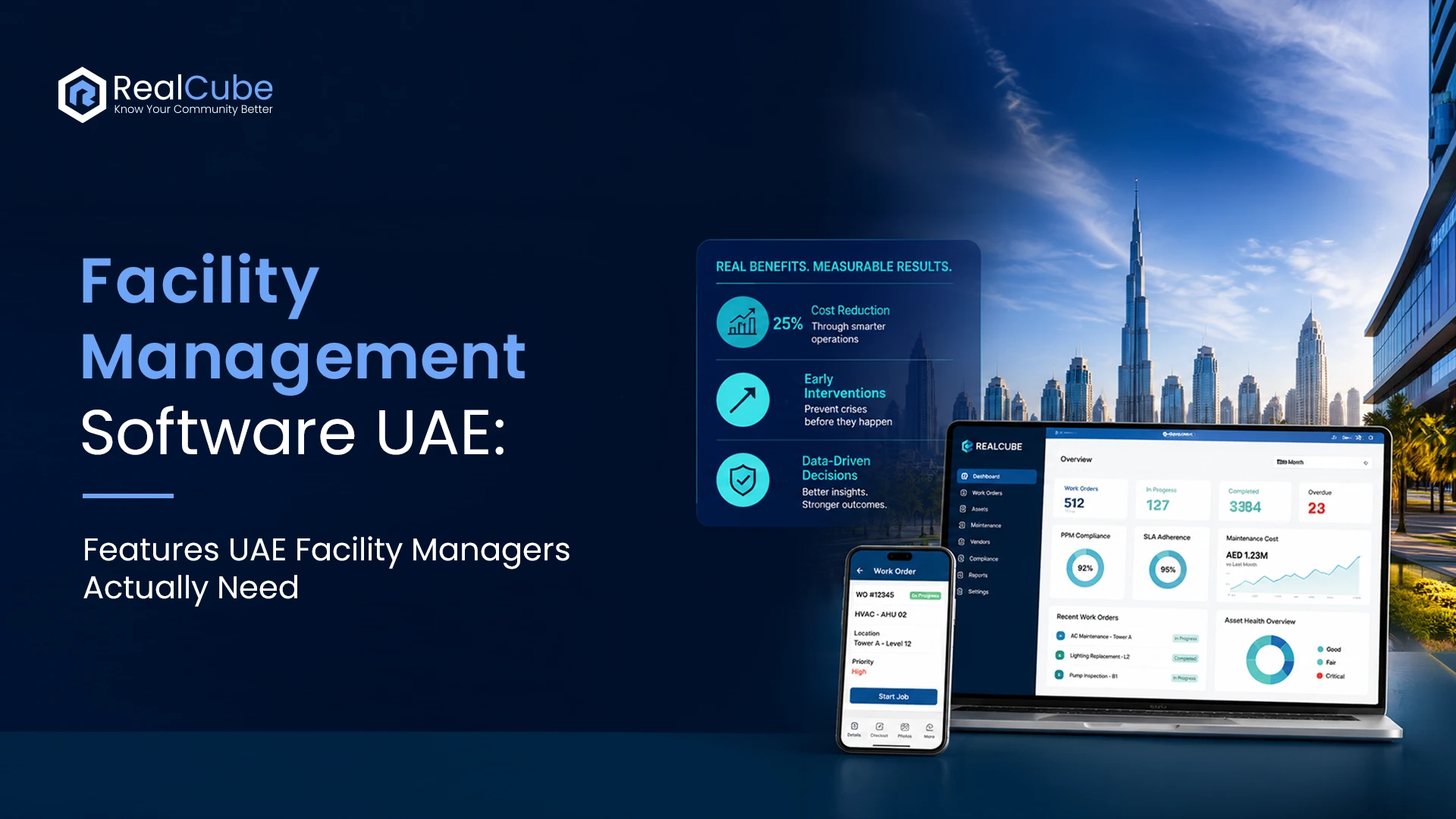
Work orders that live only on a desktop dashboard are half a solution. Field-ready work order management software lets technicians receive, view and close jobs from a mobile app - complete with SOP checklists, safety steps, photo evidence and digital sign-off - even in basements, plant rooms or low-connectivity areas via offline mode. That single change typically removes the largest source of delay in day-to-day facility operations: paperwork lag between job completion and system update.
4. SLA and Vendor Governance
Most UAE buildings depend on external contractors for cleaning, MEP, landscaping, pest control and security. Without automated SLA tracking, vendor performance is judged on memory and invoices rather than data. A capable facility management platform logs response times, job quality and completion timelines against contracted SLAs automatically, which strengthens negotiating position at renewal time and reduces service disputes.
5. Compliance-Ready Documentation and Work Permits
High-risk tasks - hot work, confined-space entry, working at height - need documented risk assessments and permits before work begins, not after an incident. Digital work permits and a full audit trail mean that when Civil Defence, Dubai Municipality or an insurer asks for records, the answer is a report, not a scramble.
6. Smart Facility Management Powered by AI
The newest generation of smart facility management platforms goes beyond scheduling and record-keeping. AI-driven engines can forecast maintenance spikes before they happen, route incoming service requests to the technician with the right skill set automatically, and flag abnormal asset behaviour - a pressure drop, an unusual energy draw - before it becomes a shutdown. This is where facility management shifts from operational housekeeping to a genuine cost and risk-reduction strategy.
7. Real-Time KPI and Cost Reporting
Facility managers are increasingly expected to speak the language of budgets, not just breakdowns. Dashboards tracking Mean Time to Repair (MTTR), PPM compliance rates, SLA adherence and maintenance spend against budget give managers - and the finance team - a shared, real-time view of operational health.
RealCube Perspective
At RealCube, our CAFM suite was built around this exact operating reality - asset hierarchies mapped to functional locations, mobile-first work orders with offline mode and barcode scanning, automated SLA governance, digital work permits, and our NOVA AI engine forecasting maintenance load and routing requests intelligently. It's facility management designed for how UAE buildings and teams actually work, not adapted from a system built for another market.
The UAE Facility Management Market, By the Numbers
The pace of investment in facility management technology across the UAE reflects how central this function has become to real estate performance and building safety.
| Market Indicator | Figure | Why It Matters |
| UAE facility management market size, 2026 | USD ~23.86 billion | Scale is outpacing spreadsheets and manual logs |
| Projected market size by 2031 | USD ~42.27 billion | 12.12% CAGR - FM is now a strategic function, not a cost centre |
| Hard services share of 2025 FM revenue | ~60.9% | MEP, fire safety and asset upkeep dominate budgets |
| Outsourced FM delivery model share | ~64.9% | Third-party vendor governance and SLA tracking are now core needs |
| Reported maintenance cost reduction with predictive/CAFM adoption | Up to 20-30% | Preventive over reactive maintenance protects budgets |
Figures compiled from third-party UAE facility management market research current as of 2026; readers should verify the latest figures with the original source before external citation or publication.
Choosing the Right CAFM Software UAE Partner
Not every platform labelled 'CAFM' delivers the same depth. When evaluating a facility management system, it's worth looking past the feature list and asking a few practical questions:
- Does the platform map assets to functional locations, or just list them?
- Can technicians close work orders offline, in basements and plant rooms with poor signal?
- Is SLA tracking automatic, or does it depend on someone manually comparing timesheets?
- Does the system generate audit-ready compliance records without extra manual entry?
- Is there a genuine AI layer - predictive maintenance and smart routing - or just static reporting?
- Does it integrate with your finance/ERP systems so maintenance costs reconcile automatically?
A platform that answers 'yes' across the board isn't just software - it's a shift in how a building, or a portfolio, is run.
Where This Leaves UAE Facility Teams
The direction of the UAE facility management market is clear: budgets are growing, compliance expectations are tightening, and the tools that succeed are the ones built specifically for this market's climate, regulatory layers and multi-vendor reality. Facility managers who move early from spreadsheets and disconnected tools to an integrated, AI-enabled facility management platform aren't just saving admin time - they're protecting asset value, tenant satisfaction, and their own ability to prove compliance when it matters most.
RealCube's Facility Management module, part of our unified property and community management platform, brings preventive maintenance, work order automation, vendor governance and NOVA AI-driven insights together in one system - built for the way UAE facilities actually operate.
Frequently Asked Questions
1. What is CAFM software and how is it different from a CMMS?
CAFM (Computer-Aided Facility Management) is a broader platform covering asset tracking, preventive maintenance, space management and vendor governance. A CMMS (Computerised Maintenance Management System) is a narrower tool focused mainly on work orders and equipment maintenance. Most modern facility management software UAE platforms, including RealCube, combine both under one system.
2. Why is preventive maintenance software important in the UAE specifically?
UAE summers push HVAC and cooling assets to their operating limits. Preventive maintenance software schedules servicing before failure occurs, which is critical here since a single missed maintenance cycle can lead to costly downtime during peak heat - far more expensive than the maintenance itself.
3. Can facility management software work without constant internet access on site?
Yes - a properly built work order management software includes offline mode, so technicians in basements, plant rooms or low-signal areas can view job details, complete checklists and capture photo evidence, with data syncing automatically once connectivity is restored.
4. How does a facility management platform help with UAE compliance requirements?
A good system maintains digital, timestamped records of maintenance, safety checks and work permits, generating audit-ready reports for Dubai Municipality, Civil Defence and utility providers on demand - replacing the manual paperwork trail that makes inspections stressful.
5. What makes a facility management system 'smart'?
Smart facility management goes beyond digital record-keeping to include AI-driven prediction - forecasting maintenance loads, automatically routing requests to the right technician, and flagging early signs of asset failure. RealCube's NOVA AI engine is built specifically for this layer of intelligence.