
Real estate development is one of the most complex undertakings in any industry. You're coordinating land banks, financial models, design consultants, procurement teams, contractors, site inspectors, and legal compliance - all at the same time, across projects that span years and hundreds of millions in capital.
The painful truth? Most developers are still trying to manage all of this across a patchwork of spreadsheets, shared folders, and disconnected email threads. Finance teams run feasibility in Excel. Design teams share drawings via email. Procurement tracks tenders in a local folder. The site manager sends weekly PDF reports that are already out of date the moment they land in someone's inbox.
The result is predictable: miscommunication, budget overruns, schedule slippages, accountability gaps, and handover documentation that nobody can find. And in a market as competitive and regulated as the UAE and broader GCC, those gaps don't just hurt your margins - they hurt your reputation.
This is exactly why a purpose-built, end-to-end Construction Project Management Software has become non-negotiable for developers who want to scale. And when we say end-to-end, we mean it - from the moment you first evaluate a plot of land to the moment you hand over the keys to the final unit.
That's the promise of RealCube PMIS. Let's walk through what that actually looks like in practice.
| USD 96B+ UAE Construction Market by 2030* | 98% Megaprojects with Cost Overruns or Delays* | $1.6T Annual Cost of Global Construction Inefficiencies* | 35% Professional Time Wasted on Non-Productive Work* |
* Sources: Research and Markets/GlobeNewswire; McKinsey Global Institute; Digital Construction Week - figures to be verified prior to external publication.
Why Construction Still Has a Data Problem
The construction industry globally accounts for roughly 13% of GDP - yet it consistently ranks among the least digitised sectors. McKinsey data suggests that global construction inefficiencies cost an estimated $1.6 trillion annually, with cost overruns running anywhere between 20% and 45% of project value. Schedule slippage averages 20 months on major projects. And 98% of megaprojects experience cost overruns or delays of some kind.
The GCC tells a similar story at enormous scale. The region awarded approximately $264.4 billion in construction contracts in 2024 alone - and as the UAE construction market races toward a projected $96 billion valuation by 2030, the operational stakes have never been higher. More projects, larger budgets, tighter timelines, and a more complex regulatory environment mean that working without a proper Construction Management Platform is simply no longer viable.
The core problem isn't a lack of skilled teams. It's a lack of connected data. When your feasibility numbers don't talk to your procurement actuals, when your design approvals aren't linked to your site schedule, and when your contractor performance isn't tracked against your original cost plan - you're flying blind on a billion-dirham project.
The Real Cost of Disconnection
Fragmented tools don't just cause inconvenience - they create structural risk. When design, procurement, and site execution live in separate systems, version conflicts and approval delays become invisible until they've already cost you weeks and budget. A unified Project Management Information System eliminates these blind spots by making all project data visible, traceable, and governed from a single source of truth.
What Is a PMIS - and Why Does It Matter for Real Estate Developers?
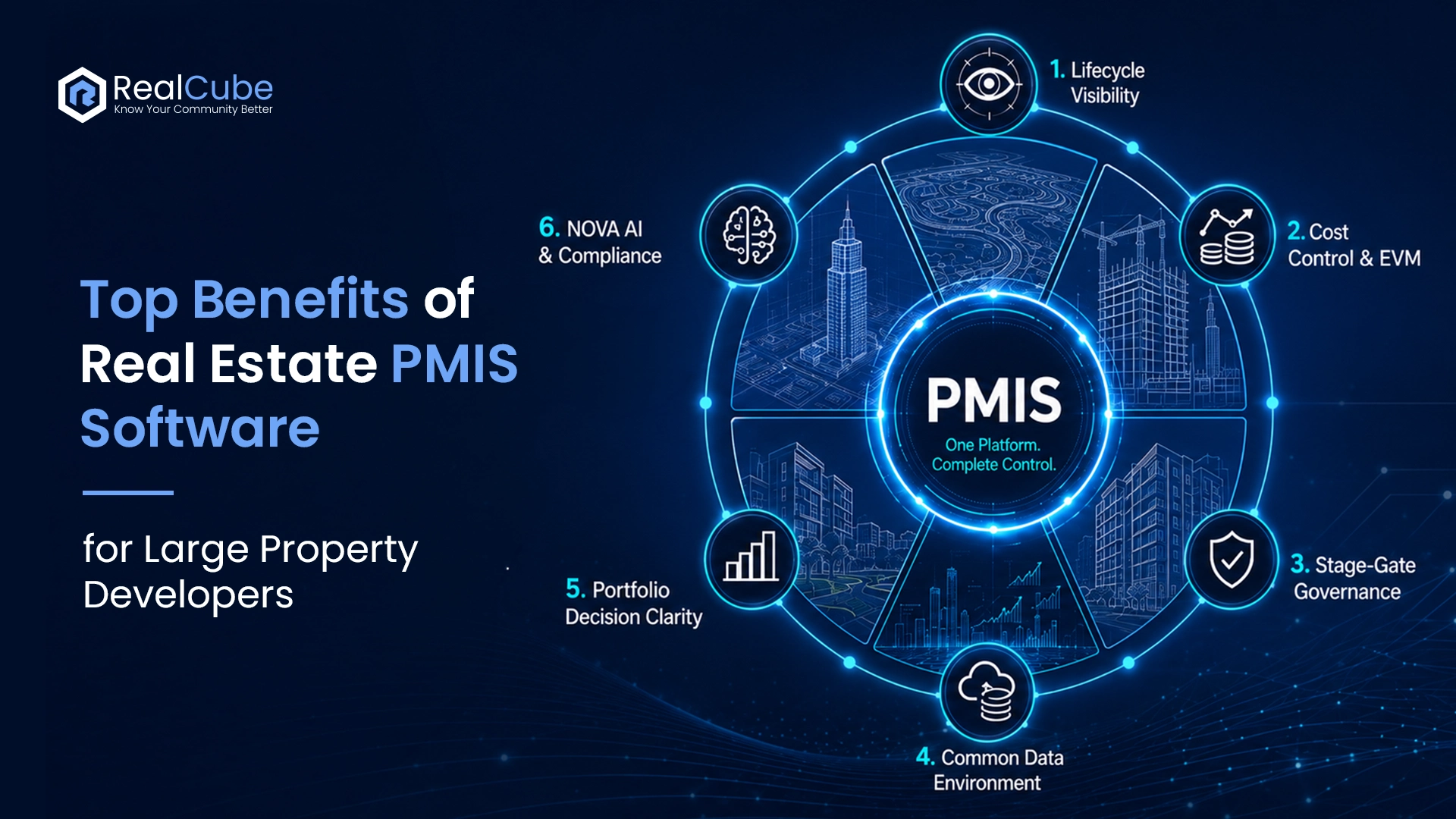
A Project Management Information System (PMIS) is a centralised digital platform that brings together every element of project delivery - planning, scheduling, budgeting, procurement, document control, risk management, and reporting - into one governed environment.
Unlike general-purpose project tools, a PMIS Software designed for construction is built around the specific workflows that define how development projects actually run: stage-gate approvals, contractor performance tracking, RFI and submittal management, Earned Value Management (EVM), tender comparisons, and regulatory compliance.
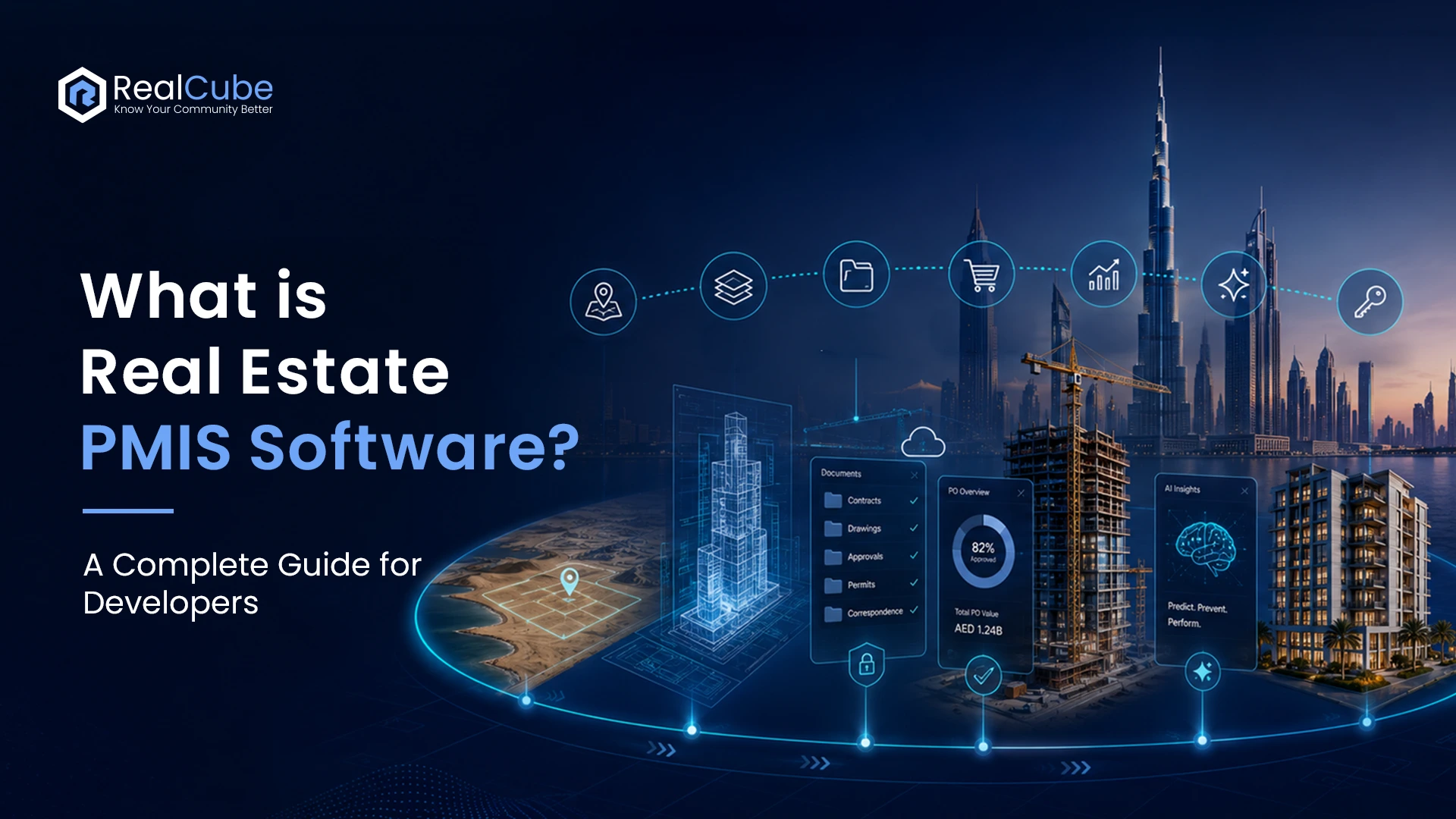
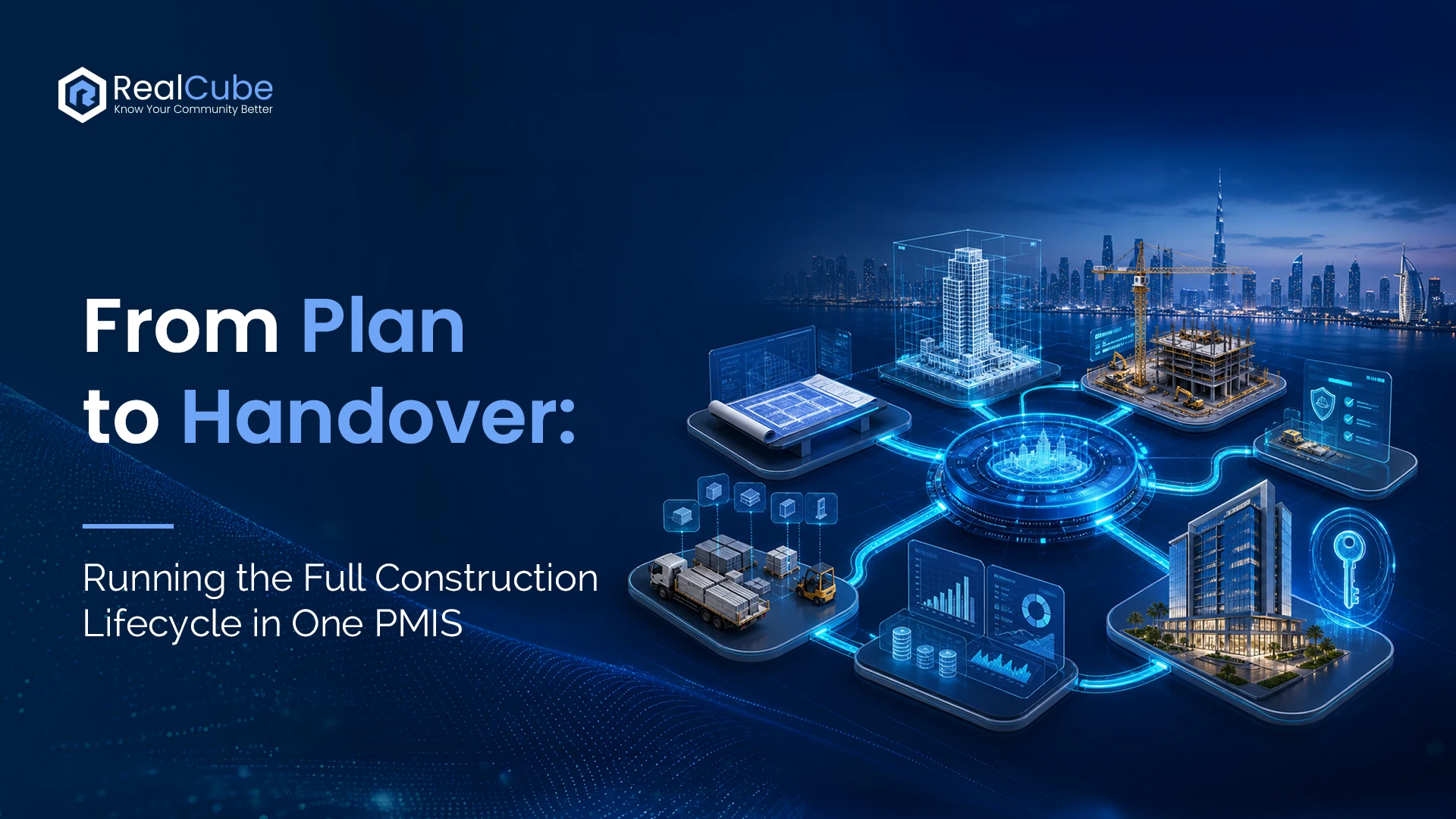
What makes RealCube's approach different is the scope. Most platforms cover one or two phases well. RealCube's Construction Lifecycle Management spans the full journey - from strategic land acquisition through to title deed management and final asset handover - inside a single cloud-native ecosystem.
Phase by Phase: How RealCube PMIS Runs the Complete Construction Lifecycle
Phase 1 - Land Acquisition & Feasibility
Every development begins with a question: Is this land worth pursuing? That question deserves a rigorous answer - not a gut feeling backed by an optimistic spreadsheet.
RealCube PMIS transforms land evaluation into a governed, data-driven process. Teams can centralise their land pipeline with precise ownership data, GIS plot coordinates, and feasibility status at a glance. Dynamic financial modelling tools - including GFA calculators, building-mix planners, and ROI scenario workbooks - replace static Excel files with live, version-controlled models that update as assumptions change. Research artifacts and market comparables sit directly alongside your financial models, giving decision-makers the full picture before a single dirham of capital is committed.
The result is faster, more confident go/no-go decisions - and a clear audit trail from the very start of the project lifecycle.
Phase 2 - Pre-Construction, Design Coordination & Tendering
Pre-construction is where many projects quietly begin to go wrong. Design iterations multiply, drawing versions diverge, consultant approvals stall in email chains, and the tender package eventually goes out with errors that nobody caught because there was no common source of truth.
RealCube addresses this with a built-in Common Data Environment (CDE) - a centralised document repository that handles drawing transmittals, BIM and CAD file management, version control, and reviewer comments in one traceable workspace. Nobody is ever working from an outdated set of drawings.
Built-in stage-gate governance ensures that a project cannot advance from design to tender without meeting pre-defined compliance and financial criteria. Once the design is approved, the platform transitions seamlessly into structured tendering workflows - from document preparation and bid issuance through post-tender validation and cost certainty at award. It is Construction Project Tracking Software that works before a single brick is laid.
Phase 3 - Procurement & Supplier Management
Procurement is one of the highest-risk phases in any construction project. The wrong contractor, an unvetted supplier, or an unchecked bid comparison can damage a project's financial performance for years.
RealCube's integrated Procurement Suite brings structure and accountability to the entire Procure-to-Pay cycle. The Supplier Portal ensures only pre-qualified vendors participate in bidding. Bid management tools allow procurement teams to compare submissions side by side, objectively and efficiently. Approval workflows make sure every contract award follows the right authorisation path - documented and auditable.
Integrations with estimation tools like Candy RIBs and Argus EstateMaster mean that your procurement actuals flow directly back into your financial models, keeping your cost plan honest throughout the project.
Phase 4 - Construction Execution & Project Controls
This is where the project either holds together or starts to unravel. Construction execution involves coordinating dozens of contractors, managing site quality, tracking safety incidents, processing change orders, and monitoring performance against the original programme - all simultaneously.
RealCube's Project Controls Software gives site and programme teams absolute real-time visibility. Contractor performance is tracked using Earned Value Management (EVM) methodology - the gold standard for measuring schedule and cost performance objectively. The platform ships with 15 pre-built digital construction forms, including Shop Drawings, Material Inspection Requests (MIR), Work Inspection Requests (WIR), and Non-Conformance Reports (NCRs), so site documentation is captured digitally, in real time, rather than chased through paperwork.
Health and Safety incident logs, configurable approval workflows, and native scheduling integration with Primavera P6 and Microsoft Project mean that your programme team has everything they need in one place. Issues are caught early. Decisions are made faster. Accountability is built in.
Phase 5 - Handover, Title Deeds & Asset Management
Handover is the moment a project pays off - and also the moment where poorly managed projects tend to fall apart. Documents can't be found. Unit inventories don't match the sales register. Title deed applications sit in manual queues. Snagging lists live in someone's personal folder.
RealCube closes the lifecycle loop by integrating handover directly into the platform. Title Deed Management handles the full deed tracking and validation process, including government API integrations where available for GIS plot rendering and deed authentication. Property inventory, launch landing pages, and validation tooling are all managed from a single "Golden Record" - a master data environment that ensures the unit you sold is exactly the unit that gets handed over.
This clean close to the project cycle is what makes Real Estate Project Management Software truly end-to-end - not just a construction tool, but a full development governance platform.
RealCube PMIS vs. Fragmented Approaches: At a Glance
| Lifecycle Stage | Without a Unified PMIS | With RealCube PMIS |
| Land Acquisition & Feasibility | Scattered Excel models, data silos, no version control | Dynamic GIS-linked models, centralised feasibility dashboard |
| Pre-Construction & Design | Email-based drawing reviews, version conflicts, audit gaps | Common Data Environment with full BIM/CAD version control |
| Tendering & Procurement | Manual bid comparisons, inconsistent vendor onboarding | Structured bid workflows, pre-qualified supplier portal |
| Construction & Project Controls | Delayed site reports, reactive decision-making | Real-time EVM tracking, 15+ digital construction forms |
| Title Deed & Handover | Manual deed tracking, handover documentation lost across teams | Automated deed management, structured handover workflow |
The NOVA AI Advantage: From Reactive to Proactive
Data is only as valuable as the decisions it enables. RealCube's PMIS is powered by NOVA AI - our proprietary intelligent engine that transforms raw project data into forward-looking insights.
Rather than waiting for a monthly progress report to discover a cost variance or a schedule risk, NOVA AI surfaces anomalies in real time. Unusual payment patterns are flagged automatically. Predictive analytics models project revenue trajectories, cost-at-completion forecasts, and schedule risk profiles before problems become crises. And through a conversational interface, project leaders can simply ask: "Which packages are running over budget?" or "Which contractors have open NCRs?" - and get an instant, data-backed answer.
This is what separates a true End-to-End Construction Software platform from a data archive. RealCube doesn't just store your project information. It works with you to protect your margins, your schedule, and your delivery reputation.
Built for the GCC - Not Retrofitted for It
Generic Western PMIS tools were built for a different regulatory and market context. They don't natively handle Title Deed workflows under DLD or RERA requirements. They weren't designed around the procurement complexity of GCC mega-project pipelines. And they certainly weren't built to integrate with regional government APIs for plot validation or escrow compliance.
RealCube was. As an Exalogic company with deep roots in UAE enterprise technology, RealCube PMIS was designed from the ground up to reflect the way real estate development actually works in this region - with the regulatory nuances, the stakeholder structures, and the market realities that GCC developers face every day.
The Construction Digital Transformation journey looks different for a developer in Dubai than it does for one in London or New York. Your platform should reflect that difference - not just tolerate it.
One Platform. The Full Picture.
The days of managing a billion-dirham development portfolio across spreadsheets and email threads are behind us - or at least, they should be. The construction industry's complexity demands a system that can hold the entire lifecycle in view, connect every team to the same data, and give leadership the confidence that comes from genuine, real-time visibility.
RealCube PMIS is that system - a unified, AI-powered, cloud-native Project Management Information System designed to take your projects from feasibility to handover without losing a single thread along the way.
Ready to transform your project delivery?
See how RealCube PMIS brings your full construction lifecycle into one governed platform. Visit www.realcube.estate/pmis or contact us at RealCube.estate to schedule a personalised demo for your team.
Frequently Asked Questions
Q: What is a PMIS and how is it different from standard project management software?
A: A Project Management Information System (PMIS) is purpose-built for complex, multi-phase development and construction projects. Unlike general task-management tools, a construction PMIS manages the full project lifecycle - covering feasibility, design, procurement, site execution, and handover - with built-in governance frameworks, stage-gate approvals, document control, and financial tracking. RealCube PMIS goes further by integrating AI-powered analytics and regional compliance features specifically designed for GCC real estate developers.
Q: Can RealCube PMIS handle large-scale portfolios with multiple concurrent projects?
A: Yes. RealCube PMIS is built for enterprise-scale portfolio management. It provides portfolio-level dashboards that give leadership a consolidated view across all active projects - covering cost performance, schedule status, procurement progress, and risk exposure - while allowing project teams to drill into the granular details of their specific assignments. The platform's cloud-native architecture ensures performance scales with your portfolio without infrastructure overhead.
Q: Does RealCube PMIS integrate with scheduling tools like Primavera P6 or Microsoft Project?
A: Absolutely. RealCube PMIS natively integrates with Primavera P6 and Microsoft Project (MSP), allowing teams to import schedules directly and visualise them as interactive Gantt charts within the platform. This means your programme team retains their preferred scheduling tool while the rest of the organisation benefits from that data being connected to budgets, procurement milestones, and contractor performance tracking in real time.
Q: How does RealCube PMIS support construction project cost control and budget management?
A: RealCube employs Earned Value Management (EVM) methodology for real-time cost and schedule performance tracking. This means project managers can see at any point whether a project is delivering value proportional to what has been spent. The platform also maintains a live connection between original cost plans, procurement actuals, and change order variations - ensuring that your cost-at-completion forecast is always based on current reality rather than stale assumptions. NOVA AI further enhances this by flagging anomalies and predicting budget risks proactively.
Q: Is RealCube PMIS suitable for real estate developers working within the UAE regulatory requirements?
A: RealCube PMIS was specifically designed to accommodate the regulatory environment of the UAE and GCC real estate development. This includes Title Deed management workflows aligned with DLD processes, integration with government land department APIs for GIS plot rendering and deed validation, Escrow compliance support, and stage-gate governance that reflects regional authority approval requirements. Unlike generic global PMIS platforms, RealCube's construction digital transformation approach is built around how GCC projects actually operate - not adapted as an afterthought.