
Every real estate developer knows the feeling: a project that started with a solid financial model begins to drift - budgets overrun, design revisions cause cascading delays, contractors work from different document versions, and nobody has a single source of truth. What starts as a manageable development project gradually becomes a complex juggling act managed across spreadsheets, email threads, and disconnected software tools.
This is not a people problem. It is an information architecture problem. And it is precisely what Real Estate PMIS Software was built to solve. If you are a developer evaluating your technology stack, or simply trying to understand what a Project Management Information System (PMIS) actually does in a real estate context, this guide breaks it down clearly - from definition to deployment.
| $26.55B Global PropTech Software Market (2025) | $52.21B Projected Market Value by 2032 | 10.1% Compound Annual Growth Rate | 15+ Pre-Built Construction Forms in RealCube PMIS |
What is Real Estate PMIS Software?
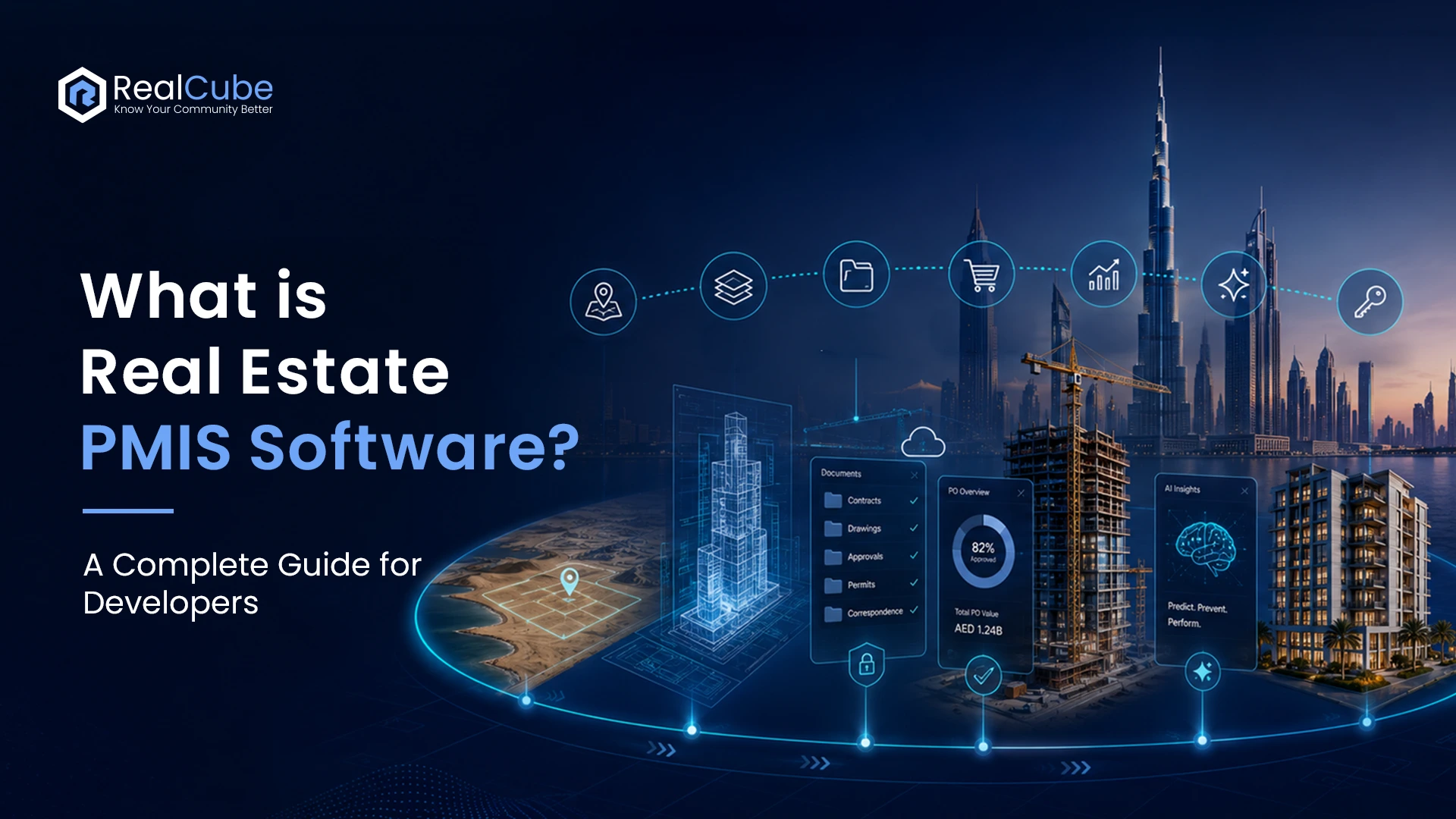
A Project Management Information System (PMIS) is a centralised, cloud-based platform that consolidates every phase of a real estate development project - from land acquisition and feasibility through design, procurement, construction, and asset handover - into a single governed digital environment.
Unlike general-purpose project management tools built for software teams or marketing agencies, Real Estate Project Management Software is designed specifically around the data model of development: land parcels, gross floor areas, contractor milestones, budget-vs-actual tracking, RFIs, submittal workflows, title deeds, and escrow compliance. It connects the strategic financial intent of a project with the operational reality on the ground.
In simple terms: a PMIS replaces the combination of Excel models, WhatsApp groups, shared drives, and standalone ERPs that most development teams rely on today - and replaces them with a single platform where every stakeholder works from the same data, in real time.
Why the Traditional Approach Breaks Down
A 2026 industry analysis found that when developers force generic project tools to run development, three things consistently happen: financial data lives in a separate system from task tracking; every report requires a manual export and spreadsheet reconciliation; and project managers spend more time moving data between systems than actually running the project.
Why Real Estate Developers Need a Dedicated PMIS
The scale and complexity of real estate development is fundamentally different from other industries. A single mid-size development project can involve land acquisition teams, architects, structural engineers, MEP consultants, multiple general contractors, subcontractors, government authority approvals, escrow requirements, and investor reporting - all happening simultaneously, across multiple phases.
The Cost of Disconnection
| Problem | Without PMIS | With PMIS for Real Estate Developers |
| Budget Control | Overruns discovered late; manual reconciliation | Real-time budget-vs-actual across all cost codes |
| Document Versions | Contractors build from outdated drawings | Single source of truth via Common Data Environment (CDE) |
| Design Approvals | Manual email chains; no audit trail | Automated stage-gate workflows with compliance checks |
| Schedule Tracking | Primavera P6 data siloed from finance team | Integrated schedule + EVM dashboard in one platform |
| Procurement | Bid comparison in spreadsheets; version risk | Structured tendering with vendor qualification and comparison |
| Reporting | Weekly exports; always one week behind | Live dashboards for portfolio-level decision clarity |
Construction Lifecycle Management: What a PMIS Covers
One of the most common misconceptions about PMIS platforms is that they are construction management tools. They are not - or rather, they are not only that. True Construction Lifecycle Management begins before a single brick is laid and continues until the completed asset is handed over or placed under long-term management.
| 01 Pre-Development Land banking, GIS visualisation, financial feasibility modelling, ROI scenario planning, and market comparables. | 02 Design & Tender Stage-gate governance, BIM/CAD document control, tendering workflows, bid comparison, and award validation. | 03 Construction & Handover Project controls, contractor performance, EVM tracking, 15+ digital site forms, H&S logs, and title deed management. |
This end-to-end lifecycle coverage is what distinguishes purpose-built Real Estate PMIS Software from point solutions like standalone scheduling tools or basic document management systems. The value is in the continuity: financial models built during feasibility remain connected to procurement budgets, which remain connected to construction cost tracking, which feeds directly into asset valuation at handover.
Core Features of a Construction Management Platform for Developers
When evaluating any PMIS for Real Estate Developers, these are the capabilities that determine whether a platform can genuinely govern a development portfolio - or simply digitise the chaos.
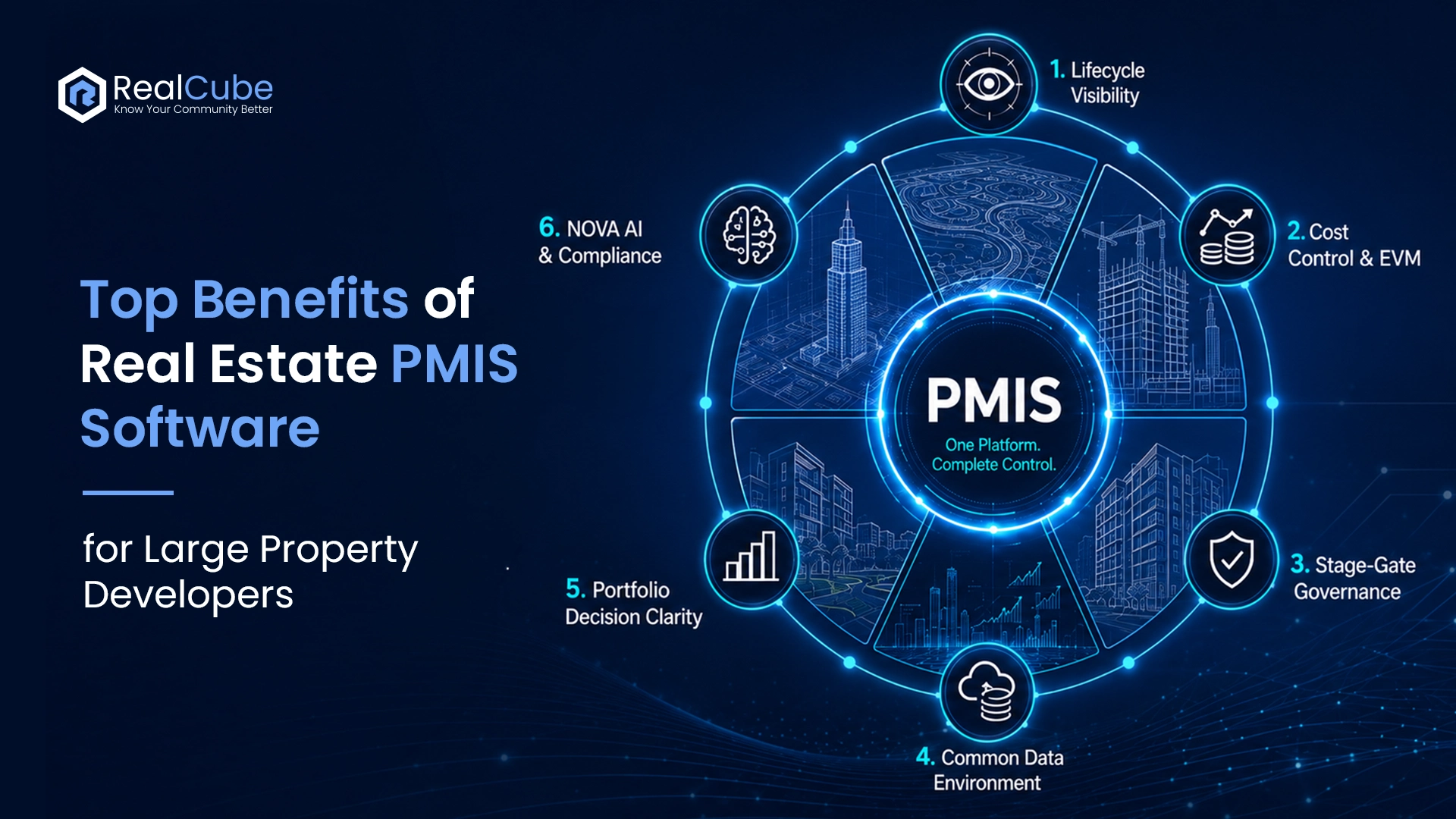
| ◈ Common Data Environment (CDE) Centralised repository for all drawings, BIM/CAD models, transmittals, and versioned documents. Every stakeholder builds from the latest approved file, with strict audit trails. | ◈ Configurable Workflow Engine Automates approvals across all project disciplines - from simple RFIs to complex budget variation orders - with consultant discretionary approvals and trigger-based auto-closures. |
| ◈ Feasibility & Financial Modelling Dynamic financial workspace with land parcel calculators, GFA planning, ROI scenario tools, and the ability to store market research directly alongside financial models. | ◈ Project Controls & EVM Earned Value Management (EVM) for real-time schedule and cost performance. Integration with Primavera P6 and Microsoft Project for Gantt visualisation. |
| ◈ Digital Construction Management Forms Pre-built digitised forms covering Shop Drawings, Material Inspection Requests (MIR), Work Inspection Requests (WIR), Non-Conformance Reports (NCRs), and H&S incident logs. | ◈ Procurement Suite & Supplier Portal End-to-end tendering from document preparation to post-award validation. Pre-qualify vendors, compare bids, and manage contractor onboarding within a structured, governed workflow. |
| ◈ Stage-Gate Governance Built-in governance ensures projects cannot advance to the next phase without meeting compliance and financial criteria. Protects capital and maintains audit integrity at every milestone. | ◈ AI-Driven Predictive Analytics Powered by NOVA AI, the platform surfaces anomalies, forecasts risks, detects irregular payments, and delivers conversational data access - transforming reactive managers into proactive strategists. |
Project Controls Software: Dedicated PMIS vs. Generic Tools
The construction and development software market has matured significantly. In 2026, the global property management and construction software market is valued at approximately $26.55 billion and projected to reach $52.21 billion by 2032, growing at 10.1% annually. Yet many development teams still rely on generic tools - Microsoft Project, Excel, Smartsheet, or even construction-first platforms like Procore - for development lifecycle management.
The key gap: generic construction tools are designed around the construction phase. They handle RFIs, submittals, and field coordination well. But they do not natively model land acquisition pipelines, feasibility scenarios, financial drawdowns, or escrow compliance requirements. For a developer running a multi-project portfolio, this means critical pre-construction and financial governance workflows still live outside the system.
Digital Construction Management platforms built specifically for real estate developers - like RealCube PMIS - address this by treating the development lifecycle, not just the construction phase, as the core data model. Every feature, from land banking to title deed management, connects within the same governed environment.
How RealCube PMIS Solves the Disconnection Problem
RealCube PMIS is built as a unified, cloud-native platform for enterprise real estate developers. Rather than requiring developers to stitch together separate tools for feasibility, design management, procurement, and construction, RealCube consolidates every workflow into a single platform - governed by a built-in compliance engine and powered by NOVA AI.
The platform is also regionally intelligent. Unlike generic Western PMIS tools that overlook regional requirements, RealCube is designed to handle UAE and GCC-specific compliance needs: Title Deed management, Escrow law requirements, and Government Land Department API integrations for GIS plot rendering and deed validation. For developers operating in the UAE market, this is not a minor advantage - it is a fundamental difference in how the platform works for your team day to day.
Built for Regional Compliance
RealCube PMIS integrates directly with government land department APIs (where available), supports UAE Title Deed tracking and Escrow compliance, and is benchmarked against global PMIS and Common Data Environment (CDE) best practices. Generic Western platforms require significant customisation to achieve the same results.
Conclusion
Real Estate PMIS Software is not a luxury for large developers - it is the governance layer that separates disciplined, scalable development from costly, reactive project management. The question for 2026 is not whether your team needs one, but whether the platform you choose is genuinely built for the complexity of real estate development or simply adapted from a general-purpose tool.
For developers operating in the UAE and GCC market, RealCube PMIS offers a unified, cloud-native platform that governs every phase from land acquisition to asset handover - with regional compliance built in, AI-powered intelligence through NOVA AI, and integrations with the scheduling and estimation tools your teams already use.
Stop Managing Development Projects with Spreadsheets.
Switch to RealCube PMIS - the platform that governs your costs, schedule, and compliance in one unified environment.
Talk to our experts – Book a Demo
www.realcube.estate/pmis | https://www.realcube.estate/
Frequently Asked Questions
Q1. What is a Project Management Information System (PMIS) in real estate?
A PMIS is a centralised, cloud-based platform that consolidates all phases of a real estate development project into one governed digital environment. It covers land acquisition, feasibility, design coordination, procurement, construction management, and asset handover - replacing the disconnected mix of spreadsheets, email chains, and point solutions that most developer teams rely on. Unlike generic project tools, a PMIS for Real Estate Developers is built around the data model of development: budgets, change orders, site forms, GFA calculations, and compliance checkpoints.
Q2. How is Real Estate PMIS Software different from construction management software like Procore?
Construction management platforms like Procore are built around the construction phase: field coordination, RFIs, submittals, and daily logs. They are strong for general contractors and owner-builder teams managing active site work. A real estate PMIS, by contrast, covers the full development lifecycle - starting from land acquisition, financial feasibility, and design stage-gate governance, through to procurement and post-construction handover. For developers managing pre-construction and portfolio-level financial governance, a purpose-built PMIS delivers capabilities that construction-first tools do not natively provide.
Q3. What are the key features to look for in PMIS for Real Estate Developers?
The essential capabilities include: a Common Data Environment (CDE) for document version control; configurable workflow automation for approvals; real-time budget-vs-actual tracking; Earned Value Management (EVM) for schedule and cost performance; integration with scheduling tools like Primavera P6 and Microsoft Project; procurement and tendering workflows; stage-gate governance for phase transitions; digitised construction inspection forms; and AI-powered anomaly detection and predictive analytics. For UAE and GCC developers, regional compliance features - Title Deed management, Escrow law support, and government API integrations - are equally important.
Q4. Can a PMIS integrate with tools our team already uses, like Primavera P6 or SAP?
Yes - purpose-built Real Estate PMIS Software is designed to integrate with existing enterprise tools rather than replace them. RealCube PMIS, for example, integrates natively with Primavera P6 and Microsoft Project for schedule data, Candy RIBs and Argus EstateMaster for estimation and valuation, and core ERP and finance systems for synchronised financial reporting. The goal is a unified data layer, not another disconnected tool.
Q5. What does Digital Construction Management mean in a practical, day-to-day sense for a developer?
In practice, Digital Construction Management means that site teams no longer submit paper inspection forms or email-based snag reports. Instead, inspections, Non-Conformance Reports, Material Inspection Requests, and Health & Safety logs are all captured digitally in real time through standardised platform workflows. Project managers see live contractor performance data and earned value metrics on a single dashboard. Approvals flow through automated workflows with audit trails. And leadership gets portfolio-level reporting without waiting for weekly spreadsheet exports. The result is faster decisions, fewer surprises, and a complete audit trail from pre-construction to handover.