
Why Large Developers Can No Longer Afford Disconnected Project Management
Managing a large real estate development portfolio has always been complex. But in 2026, the stakes are higher than ever. As property developers across the UAE and GCC scale their ambitions - from master-planned communities to mixed-use high-rises and commercial districts worth billions - the technology gap between how projects are managed today and how they need to be managed tomorrow is becoming impossible to ignore.
The uncomfortable truth is that most large developers are still running billion-dirham programmes on spreadsheets, email threads, and legacy tools that were never designed for the complexity of modern real estate project management. The result? Budget overruns that appear only in monthly reports, approval gaps that let unauthorized variations slip through, and a total absence of real-time visibility across the portfolio. The cost of this disconnection is measured not just in financial losses but in delayed launches, strained contractor relationships, and reputational damage.
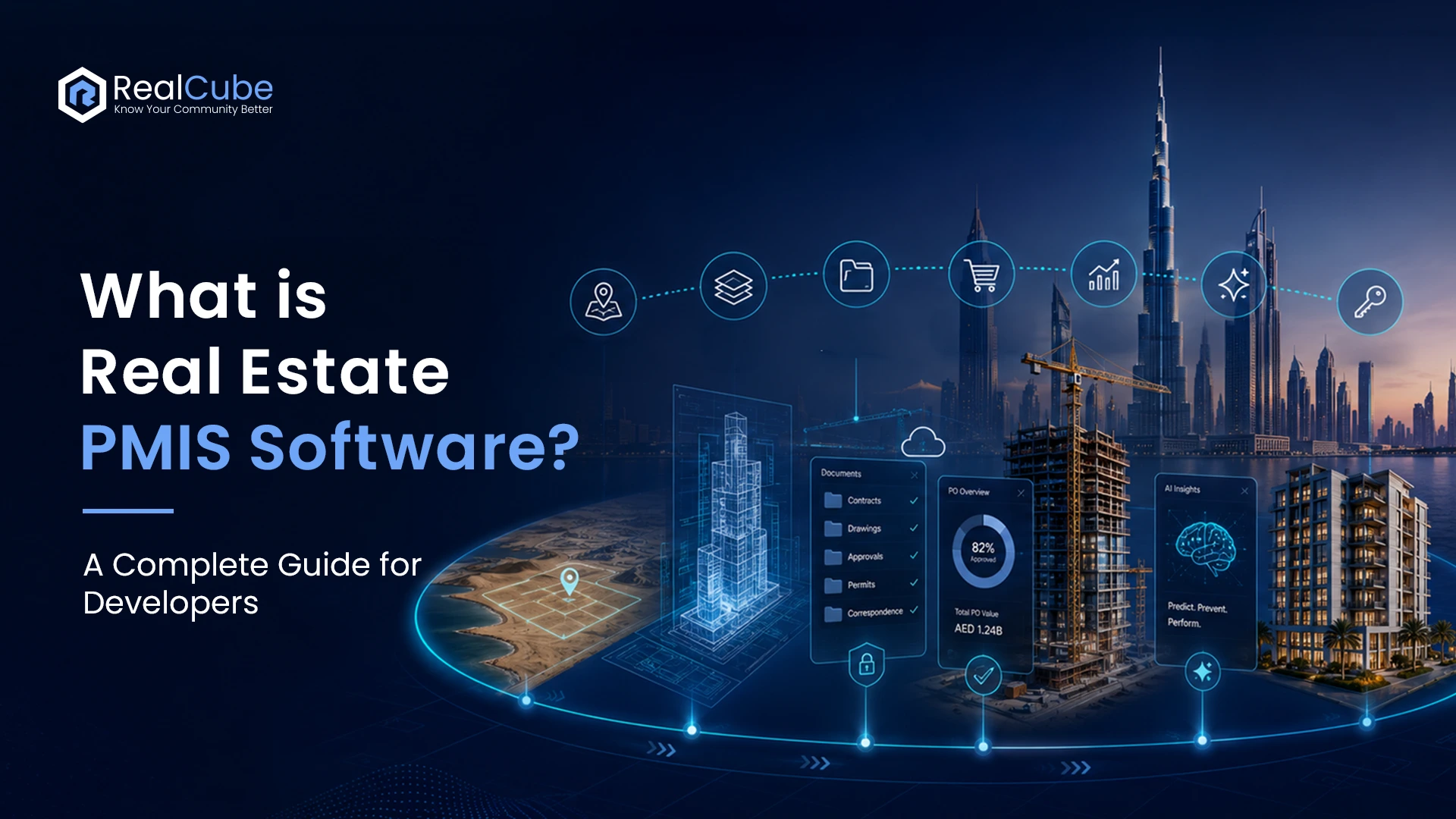
Real Estate PMIS Software changes the equation entirely. A purpose-built Project Management Information System (PMIS) brings every phase of the development lifecycle - from land acquisition and feasibility modelling through design coordination, procurement, construction, and title deed handover - onto a single governed platform. This blog breaks down the most significant benefits that RealCube PMIS delivers for large property developers - and why it represents the most important investment in your project controls capability today.
| 6x Labor Productivity Uplift from PMIS investment - per KPMG research | 7x ROI In direct cost savings on time & materials (KPMG) | ≤18 mo Budget Overruns Detected earlier with EVM - reducing overrun exposure | 100% Audit Traceability On every drawing, variation & approval in RealCube CDE |
A Region Building at Scale - With Unique Demands
The UAE real estate market is operating at an extraordinary scale. Dubai's Real Estate Regulatory Agency (RERA) and Abu Dhabi's regulatory frameworks set complex compliance requirements around Escrow accounts, Title Deed registrations, and development approval stages that generic Western platforms are completely unequipped to handle. For developers working under these regulatory structures, a construction management platform that does not natively speak to these requirements creates its own layer of project risk.
Add to this the sheer ambition of ongoing development programmes - multi-tower residential communities, integrated hospitality assets, mixed-use economic zones - and the need for a dedicated enterprise PMIS software platform becomes self-evident. UAE developers are not managing one project at a time. They are managing portfolios, and they need technology that governs the full lifecycle of every asset simultaneously, with the regional compliance intelligence built in from the ground up.
RealCube PMIS is purpose-built for this reality. Benchmarked against global PMIS and CDE best practices, and natively aligned to UAE regulatory frameworks, it gives large property developers the governance infrastructure to move fast, spend wisely, and deliver with confidence.
5 Pain Points That Cost Large Developers the Most
| # | Pain Point | Why It Hurts Large Developers |
| 01 | Disconnected Systems & Data Silos | Land banks, design consultants, and contractors operate in isolation. Version conflicts, audit risks, and duplicate data are inevitable. |
| 02 | Budget Overruns Without Early Warning | Without real-time EVM, cost deviations only surface in monthly reports - long after the window to intervene has closed. |
| 03 | Governance & Approval Gaps | Manual approvals allow unauthorised variations and budget changes to proceed unchecked, compounding financial exposure across a portfolio. |
| 04 | No Portfolio-Level Visibility | When each project operates independently, leadership cannot see risk trends, milestone slippage, or capital exposure across all active developments simultaneously. |
| 05 | Regulatory & Compliance Complexity | UAE developers must navigate Title Deed validation, Escrow laws, and authority-specific requirements - tasks that generic Western PMIS tools are not built for. |
8 Game-Changing Benefits of RealCube PMIS for Property Developers
Here is what a real estate development software platform built for large-scale, enterprise-grade project delivery actually delivers across the full construction lifecycle.
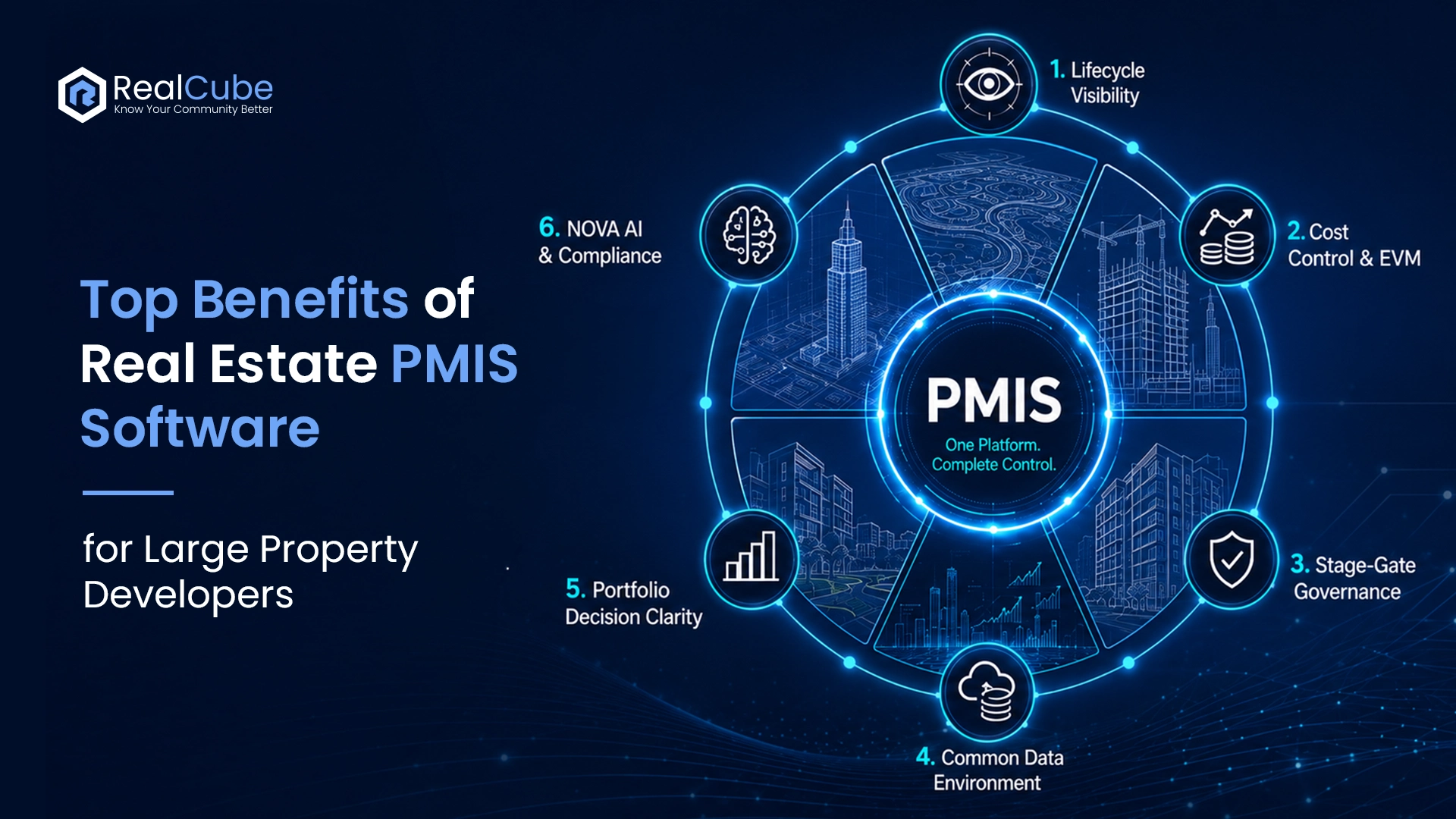
| 01 Unified Lifecycle Visibility From land acquisition and feasibility through design, construction, and title deed - every phase on one governed platform with zero data gaps. | 02 Real-Time Cost Control & EVM Track contractor performance and earned value in real time. Spot budget deviations early and act before they compound into costly overruns. |
| 03 Stage-Gate Governance Projects cannot advance to the next phase without meeting defined compliance and financial criteria - eliminating rogue variations and scope creep. | 04 Common Data Environment (CDE) A single source of truth for all drawings, BIM/CAD models, transmittals, and documents. Everyone works from the latest approved version - always. |
| 05 Portfolio-Level Decision Clarity Leadership dashboards surface risk, milestone status, and capital exposure across every active development - in real time, not monthly spreadsheets. | 06 AI-Powered Intelligence via NOVA AI Predictive analytics, anomaly detection, and conversational data queries transform your team from reactive managers to proactive decision-makers. |
| 07 Streamlined Procurement & Tendering Manage RFQs, bid comparisons, vendor pre-qualification, and contract awards from within the platform. Cost certainty at award, every time. | 08 UAE & GCC Regulatory Compliance Built-in Title Deed management, Escrow law alignment, and government API integrations that generic Western PMIS platforms simply cannot match. |
From Land Acquisition to Title Deed - In One Platform
End-to-End Construction Lifecycle Management
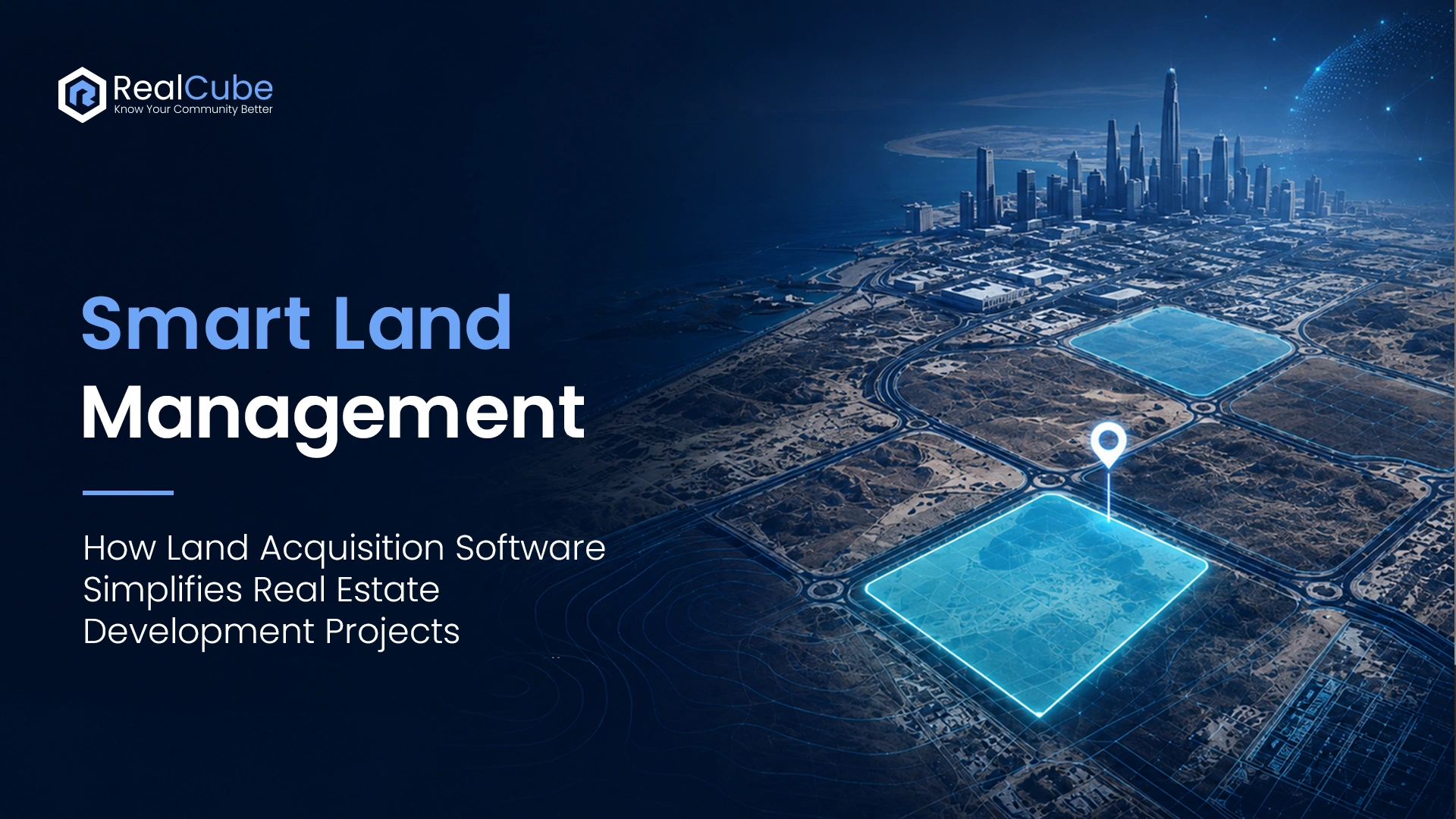
Most real estate project management software solutions are built around the construction phase alone. RealCube PMIS is fundamentally different: it governs the entire asset journey. The Land Banking module transforms raw land opportunities into structured acquisition pipelines with GIS plot rendering and colour-coded feasibility states. The Feasibility & Financial Modelling workspace replaces static spreadsheets with dynamic ROI scenario tools - all linked to the actual cost models that will govern procurement downstream.
This continuity matters enormously. When the feasibility model is connected to the pre-construction estimates, and those estimates feed directly into the tendering and procurement workflow, you eliminate the margin erosion that typically happens when financial models disconnect from construction reality. For large developers managing dozens of active projects, this lifecycle coherence is the difference between predictable delivery and perpetual fire-fighting.
Project Controls Software That Actually Controls Projects
RealCube's Project Controls module brings real-time Earned Value Management (EVM), contractor performance tracking, and 15 pre-built construction forms - including Shop Drawings, MIR, WIR, and NCRs - into one structured workflow. Health and safety incident logs, quality records, and schedule performance are monitored on a single dashboard rather than scattered across contractor submissions and consultant reports.
When integrated with Primavera P6 or Microsoft Project, RealCube's Gantt visualisation gives project directors a live picture of schedule performance across the entire portfolio. Not the picture from last month's report. The picture right now.
NOVA AI: The Intelligence Layer That Sets RealCube Apart
Beyond data management, RealCube PMIS includes NOVA AI - a proprietary intelligent analytics engine that elevates decision-making from reactive to proactive. NOVA AI delivers predictive analytics on cost trends and revenue projections, automatic anomaly detection for irregular payments or duplicate contracts, and a conversational interface that lets your team query live project data without running manual reports. For large developers managing portfolios with complex inter-dependencies, this level of embedded intelligence is genuinely transformational.
Measured Outcomes Across Your Development Portfolio
| KPI Area | How RealCube PMIS Delivers | Developer Outcome |
| Budget Governance | Stage-gate approvals block unauthorized variations at every phase transition. | Fewer cost overruns; full financial audit trail |
| Schedule Performance | Integrated Primavera P6 / MSP feeds live Gantt charts across all projects. | Earlier identification of milestone delays |
| Document Accuracy | CDE version control ensures all teams work from the single latest file. | Zero version conflict; reduced rework |
| Procurement Efficiency | End-to-end tendering from brief to award within one governed workflow. | Faster RFQ cycles; better vendor pricing |
| Portfolio Oversight | Real-time dashboards aggregate cost, schedule & risk across all projects. | Data-driven capital reallocation decisions |
| Compliance Assurance | Title Deed, Escrow, and government API integrations built in natively. | Audit-ready, regulator-ready at all times |
5 Best Practices for Implementing PMIS in a Large Property Portfolio
1. Start With a Lifecycle Audit, Not Just a Tool Selection
Before selecting any real estate development software, map every phase of your current development process and identify where information breaks down. The best PMIS implementations begin with a clear picture of your specific governance gaps - whether those are in feasibility modelling, procurement controls, or construction reporting - and then configure the platform to close those gaps first.
2. Enforce Stage-Gate Governance From Day One
The most common mistake in PMIS adoption is turning the system into a reporting tool rather than a governance engine. From the first project onboarded, enforce stage-gate rules that block phase transitions without approval. The discipline this creates compounds over time - turning construction lifecycle management from an aspiration into an operational reality.
3. Integrate Your Scheduling and Estimation Tools
RealCube PMIS is most powerful when connected to your existing scheduling and estimation ecosystem. Integrating Primavera P6, Candy RIBs, and your ERP finance system from day one means your platform reflects actual programme performance - not a parallel system that needs manual reconciliation.
4. Build Your Common Data Environment Before You Need It
Document chaos is the silent project killer. Set up your CDE structure - drawing registers, transmittal workflows, BIM/CAD naming conventions - before the first package goes out for tender. The cost of retrospectively organising document libraries mid-project is far higher than the time invested in structuring them correctly at the outset.
5. Use Portfolio Dashboards to Drive Executive Accountability
The portfolio visibility that enterprise PMIS software provides is only valuable if leadership uses it. Establish a cadence of portfolio-level reviews driven by RealCube's live dashboards. When executives make capital allocation, risk escalation, and programme decisions based on real-time data rather than month-old reports, the entire organisation's project delivery capability improves.
Stop Managing Billion-Dollar Projects with Spreadsheets
See how RealCube PMIS governs your costs, schedule, and compliance in one unified platform.
Schedule a demo.
www.realcube.estate/pmis | https://www.realcube.estate/
CONCLUSION
They stopped managing their projects with tools that were never designed for the complexity of large-scale real estate development. They made the decision - early - to invest in a platform that governs the full construction lifecycle, connects their teams on a single source of truth, and gives leadership the real-time visibility to make faster, better-informed decisions.
RealCube PMIS exists precisely for this purpose. As an enterprise PMIS software platform purpose-built for the UAE and GCC development market, it closes the gap between strategic intent and on-the-ground delivery that costs large property developers millions each year. From land banking through title deed management, every module is designed to bring discipline, transparency, and intelligence to the way you build.
The question is not whether your portfolio needs a PMIS. The question is how much longer you can afford to operate without one. Get a demo today and see what governed, intelligent, end-to-end project management looks like for your development business.
FREQUENTLY ASKED QUESTIONS
Q1. What is Real Estate PMIS Software, and do large property developers really need it?
A Project Management Information System (PMIS) for real estate is a centralised digital platform that governs every phase of a development - from land acquisition and feasibility through design coordination, construction, procurement, and asset handover. For large property developers managing multi-project portfolios worth hundreds of millions, the answer is unequivocal: yes. Without a dedicated PMIS, teams rely on disconnected spreadsheets, email chains, and siloed tools that create version conflicts, approval gaps, and budget overruns that compound across every project in the pipeline. RealCube PMIS replaces that fragmentation with a single governed platform purpose-built for enterprise-scale real estate development.
Q2. How does RealCube PMIS help control construction budgets and prevent cost overruns?
RealCube PMIS integrates real-time Earned Value Management (EVM) directly into the construction phase, allowing development teams to track contractor performance, monitor planned vs. actual costs, and identify deviations before they become critical. Stage-gate governance ensures that no project can proceed to the next phase - say, from design to tender - without meeting defined financial criteria. This combination of live cost intelligence and automated approval controls eliminates the reactive month-end reporting cycle that leaves developers managing damage rather than preventing it. The platform also flags anomalies through NOVA AI, acting as a 24/7 internal financial auditor across your entire portfolio.
Q3. What makes RealCube PMIS different from generic Western construction management platforms?
Most generic construction project management software platforms are built for Western markets and general contractors - meaning they handle the construction phase adequately but miss everything that makes large-scale real estate development in the UAE and GCC uniquely complex. RealCube PMIS covers the entire development lifecycle from land banking through title deed management. It includes native integrations with government land department APIs for GIS plot rendering and deed validation, built-in Escrow law compliance, and a regional data model that reflects how UAE developers actually work. Benchmarked against global PMIS and CDE best practices, it is the only enterprise PMIS software in the market purpose-built for this region.
Q4. Can RealCube PMIS manage multiple development projects simultaneously?
Yes - and portfolio management is one of RealCube PMIS's core strengths. Leadership dashboards aggregate cost performance, milestone status, schedule risk, and capital exposure across every active development in real time. This means executives no longer need to wait for project managers to compile manual status reports; the portfolio view is always live and always current. The platform also supports a master data management layer that maintains consistency of property and project data across all developments, ensuring that portfolio-level reporting is built on a reliable "golden record" rather than fragmented inputs.
Q5. Does RealCube PMIS integrate with scheduling tools like Primavera P6 and Microsoft Project?
Yes. RealCube PMIS offers native integrations with Primavera P6 and Microsoft Project (MSP), enabling seamless schedule imports and live Gantt chart visualisation within the platform. For estimation and valuation, it connects with Candy RIBs and Argus EstateMaster. On the financial side, ERP and finance system integrations ensure synchronized financial reporting and payment gateway configuration without manual data transfer. This integration ecosystem means RealCube does not replace your existing enterprise tools - it connects them into one governed, visible construction management platform that eliminates the data silos holding your projects back.